AI Websites for Ecommerce: Friction Is the Only Enemy
Shoppers do not owe you patience. Slow gallery loads, jumping prices, and mystery shipping train them to open Amazon in the next tab.
Product Pages: The Real Homepage
Most revenue touches PDP first from ads, social, or search. We prioritize:
- Image discipline—right formats, responsive srcset, no carousel-induced CLS.
- Variant clarity—size, color, bundle logic obvious on mobile.
- Trust micro-moments—returns, guarantees, delivery windows next to the buy button.
Category & Collection UX
Filters should feel predictable, not like a slot machine. We design facet patterns that shoppers learn once and reuse—especially for apparel, parts, and consumables.
Checkout: Calm Under Pressure
Progress cues, editable cart, payment trust badges, and error copy that tells them how to fix the issue—no generic "something went wrong" panic.
Operations Story Sells
Shipping cutoffs, carrier options, and fulfillment coverage belong in the UX—not only in post-purchase email. (The SEO vertical covers programmatic fulfillment maps when data supports them.)
Catalog SEO, Facets, Fulfillment Maps & Product Schema
Merchandising UX is above. Here is how we handle SEO at catalog scale.
Catalog SEO Without Duplicate Product Bloat
Shoppers search product + modifier—"organic dog food grain free," "running shoes wide toe box." Winning takes clean taxonomy, unique PDPs, and facet rules that do not spawn infinite thin URLs. Workflows can generate variant-aware titles, meta, and body modules that stay specific to each SKU cluster.
Categories, Facets & Canonical Discipline
- Category pages with editorial intros, FAQs, and curated bestsellers—not empty grids.
- Facet navigation with selective indexation (index high-value filters; noindex or canonicalize low-value combinations).
- Pagination and parameter handling that preserves equity to parent categories.
- Internal linking from guides and comparisons into money URLs.
At 500–5,000+ SKUs, governance matters more than blog volume.
Fulfillment & Reach Maps
When delivery footprint is a trust lever, we add programmatic reach maps:
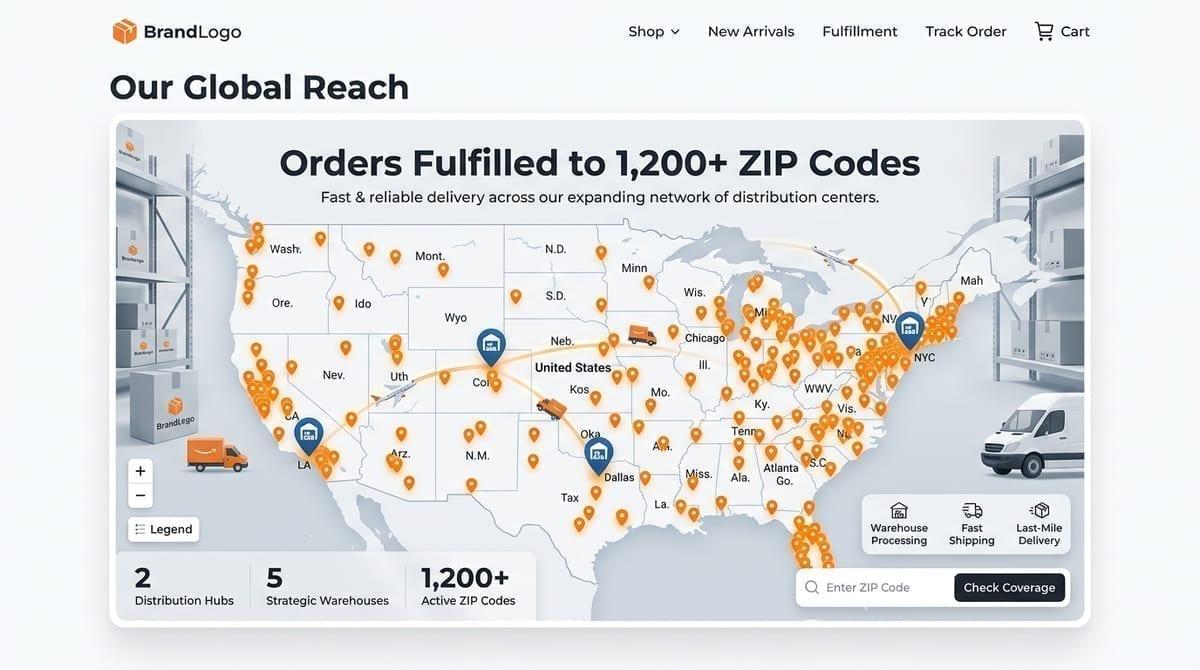
- ZIP-, region-, or country-level heat maps from your OMS—no customer addresses on pins.
- Headline counts tied to real data with clear definitions.
- Operational copy beside the map: cutoffs, carriers, cold-chain notes—useful content, not decoration.
Product Schema, Merchant Listings & Reviews
Product JSON-LD aligned with price, availability, SKU, and your review policies. Organization / OnlineStore for brand queries. Stars in SERPs only when reviews are visible and policy-compliant. Image SEO uses descriptive filenames and alt text aligned to what shoppers see—not stuffing.
For programmatic SEO strategy at massive scale, see Programmatic SEO with AI.
Getting Started
- Preview — See your catalog skinned in a fast, mobile-first layout.
- Build — Connect feed, promos, and checkout handoff you already trust.
- Launch — Measure RUM, iterate on merchandising, keep the stack boring.
Bottom Line
Speed is merchandising. Treat every millisecond like shelf space—because on mobile, it is.
Sell faster.