AI Websites for Realtors: Be the Agent Whose Site Feels Effortless
Buying or selling a home is emotional. Your website should feel calm, fast, and human—not like a 2014 IDX template that groans under forty tracking scripts.
What Buyers Need in the First Ten Seconds
- Big, fast photos and a layout that does not jump while images load.
- Neighborhood context—schools, commute, vibe—in scannable chunks.
- One clear action: text you, book a tour, or save the search.
What Sellers Need Before They Fill Out a Form
- Proof you market homes seriously (media, strategy, communication).
- A simple listing or valuation path without interrogating them upfront.
- Your face and voice—people hire agents, not logos.
Mobile Is the Showing
Open houses, drive-bys, Zillow-to-agent handoffs—most touches are on the phone. We design thumb zones, sticky contact, and readable type so you never lose a lead to friction.
IDX + Performance
Feeds are necessary; bloat is not. We structure listing shells, caching, and progressive media so Core Web Vitals stay in a healthy range—especially on search and gallery routes.
Hyperlocal SEO, Sold-Activity Maps & Real Estate Schema
Listing UX is above. Here is how we approach discoverability without thin neighborhood spam.
Hyperlocal SEO Without Thin Neighborhood Spam
Buyers and sellers search place + intent—"homes for sale in [neighborhood]," "[city] realtor." Beating portals requires unique local utility on every URL: schools, commute anchors, price context, and your POV—not interchangeable fluff with a swapped ZIP.
Neighborhood & City Page System
- Neighborhood guides with distinct hooks (architecture era, flood zones, new construction, walkability) where accurate.
- Buyer vs. seller angles on high-value cities so pages do not cannibalize.
- Internal linking from market hubs → neighborhoods → listing types you want to push.
- Freshness via market modules (inventory, median, days on market) from data you are licensed to publish—never fabricated stats.
IDX/MLS rules always win: we only render what your feed and board allow.
Sold-Activity Maps (Privacy-Safe Proof)
Portals show inventory; you can show execution without exposing client addresses.
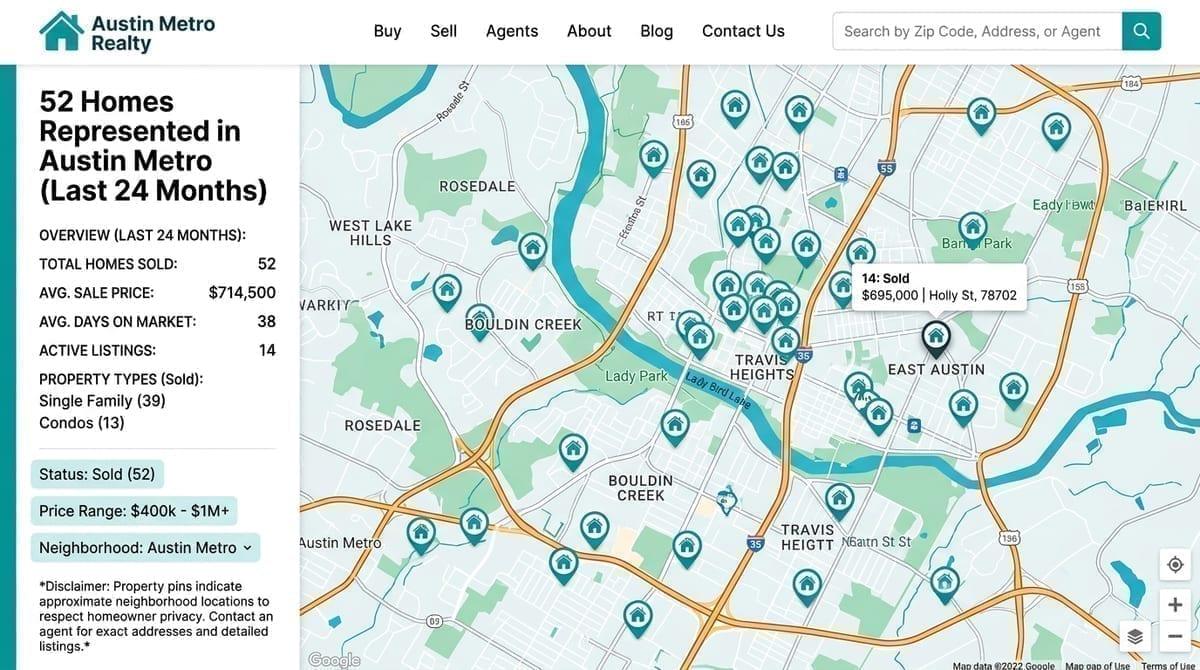
- Approximate locations of sides you represented (buyer, seller, or both—per your policy).
- Aggregated counts per city or neighborhood matching headline and map density.
- Pins use offsets or centroids—not rooftops—consistent with MLS privacy norms.
- Micro-captions (e.g. "Townhome closing, 18-day contract") add unique text without identifying parties.
- Optional rolling time windows keep the story current.
Structured Data & Listing Pages
Where permitted: RealEstateListing, Product when applicable, LocalBusiness / ProfessionalService, and FAQ aligned with visible content. Canonical rules protect parameterized search URLs from index bloat; category and neighborhood pages get clean, stable URLs.
For programmatic real estate at scale, see Programmatic SEO with AI.
Getting Started
- Preview — See your brand, colors, and listing layout in a mobile-first shell.
- Build — Wire buyer/seller paths, about, neighborhoods, and compliance-friendly disclosures.
- Launch — Ship fast, iterate on copy and seasonal campaigns without a plugin graveyard.
Bottom Line
Listings are your inventory; trust is your product. A fast, beautiful site proves you will represent their home the same way you represent your brand—intentionally.
Let's make that obvious in the first scroll.