AI Websites for Plumbers: When the Pipe Bursts, They Call the Site That Loads
Basement flooding at midnight. A water heater that quits before a holiday dinner. A main line backup on a Sunday.
Those people are not comparing five blog posts—they are picking the first credible business whose site loads now and shows how to reach you now.
If your site is slow, buried in sliders, or hides the phone number behind a hamburger menu, you are donating that job to whoever got the UX right.
The Two Mindsets You Must Design For
Panic mode (emergency)
They search on a phone, one hand on the flashlight. They need:
- Proof you are real (license, insured, local).
- Proof you answer after hours.
- One obvious action: call.
We put tap-to-call in the header, hero, and a persistent mobile action. No hunting.
Planning mode (replacements, remodels)
They will open a few tabs. They want clarity on scope, rough process, and social proof. We give scannable service pages, short process blocks, and galleries that load fast enough that they actually see your work.
What a High-Converting Plumber Site Includes
Above-the-fold emergency promise
Not a tiny “contact us” link. Clear language: 24/7 emergency, response framing you can honor, and the number as the primary CTA.
Service pages that match how people ask
Drain cleaning, water heaters, leak detection, sewer, repipes—each with plain-language symptoms (“gurgling drains,” “no hot water,” “water in the yard”) and a direct path to call or request service.
Trust stack
- License and insurance called out early.
- Reviews near CTAs.
- Guarantees and warranties where they reduce hesitation.
Photo proof without performance debt
Tank installs, repipes, clean trenchless jobs—shown with captions and short context. Images are delivered efficiently so PageSpeed does not torpedo conversions.
Mobile Is Non-Negotiable
Most emergency searches are mobile on weak signal. Thumb-sized targets, no pinching to read the number, forms that do not demand a novel in a crisis.
Programmatic SEO, Job Maps & Local Search
Above: emergency UX and conversion. Below: how we scale discoverability for plumbing companies without thin, duplicate city pages.
Technical and Programmatic SEO for Plumbing
"Emergency plumber near me." "Drain cleaning in [city]." "Water heater repair [neighborhood]." Local plumbing is won in the map pack, local organic results, and long-tail service + city combinations. That takes fast pages, clean information architecture, and proof of real work in each market—not one homepage pretending to rank everywhere.
Service + City Architecture (Without Thin Pages)
- Service intent pages: drain cleaning, water heaters, leak detection, sewer, repipes—each with clear scope, FAQs, and internal links into the cities you serve.
- City and neighborhood pages: unique local angles (water hardness, freeze risk, HOA-heavy suburbs, older housing stock) so pages are genuinely useful—not boilerplate with a swapped city name.
- Internal linking: hubs link to services and locations; locations link back to the right service pages so crawlers and users both understand your coverage.
Programmatic Job Maps: Proof of Work in Every City
Showing how much work you have done where you say you work is a high-trust signal. On city and service-area pages we can deploy programmatic job maps:
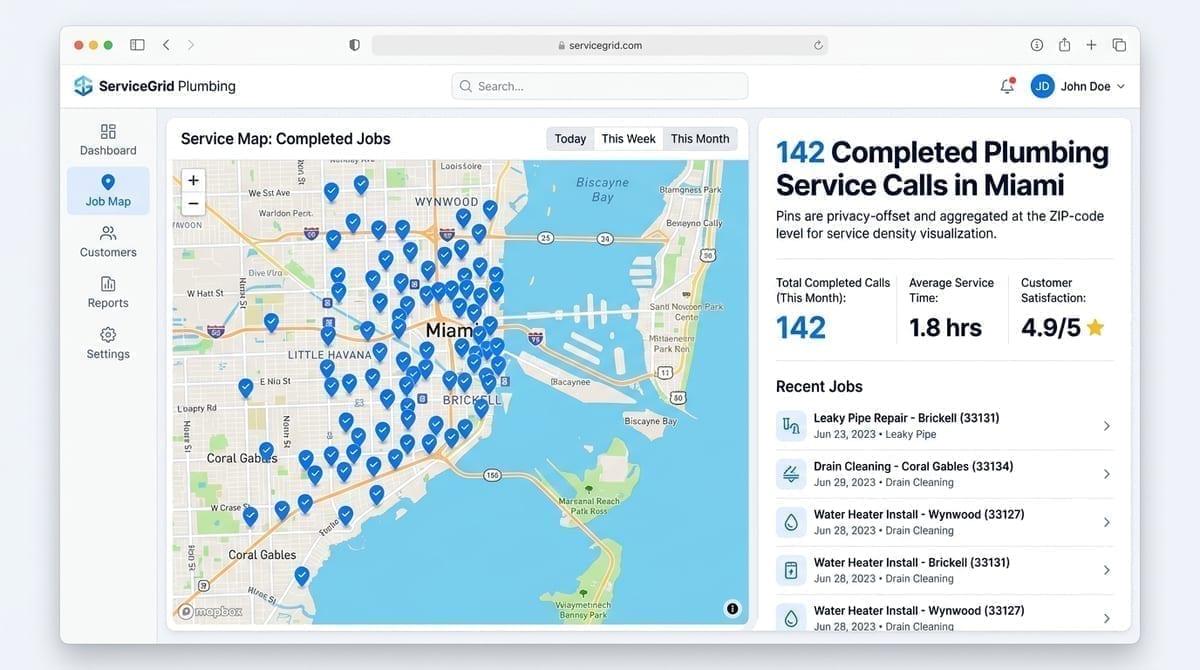
- Aggregate counts (completed jobs in that city for that service) match the map and copy—no inflated claims.
- Privacy-safe pins: offsets and ZIP- or block-level placement—not exact rooftops.
- Short job blurbs from crew notes (scope, equipment, timeline) add unique, entity-rich text per page.
- Freshness: as jobs complete, data can roll forward so localized pages reflect real activity.
Schema, NAP, and Map-Pack Alignment
We align name, address, phone, hours, and service area with your Google Business Profile and on-page copy. Structured data typically includes LocalBusiness (or a more specific subtype), Service for major trade lines, and FAQPage only where FAQs are visible. Emergency and 24/7 messaging stays consistent in copy, structured data, and CTAs so SERP expectations match the landing page.
For very large page sets at scale, see Programmatic SEO with AI.
Getting Started
- Preview — See your brand in an emergency-ready layout with real mobile CTAs.
- Build — Services, trust content, galleries, and contact paths wired the way dispatch actually works.
- Launch — Go live without maintaining a fragile CMS; iterate copy when you need to.
Bottom Line
You are not paid for “traffic.” You are paid for trucks rolling.
A plumber’s website should make calling you the path of least resistance—the second the customer realizes they have a problem.
Fast. Clear. Credible. One tap to your crew.
That is what we build.